Bee Hive Cake

I decorated this 3 layer lemon and honey cake (recipe here) with lemon Swiss meringue buttercream (recipe here) and fondant bees.

I started by covering the cake drum in green fondant. I lightly wet the drum using a pastry brush dipped in water, then draped the green fondant (which had been rolled out to around 2mm) over the top. I smoothed the fondant with a smoothing tool. Using a sharp knife, I trimmed the edges of the fondant so that it was in line with the edge of the cake drum. I then stuck the green ribbon around the edge using double sided tape. For a bit of extra fun, I stuck little bees around the edge.

Next I made the bees. I rolled small amounts of yellow fondant into cylinders. Then I rolled out black fondant to about 1mm thick and cut out strips. I used a small amount of water to stick the strips to the yellow fondant; a fine paintbrush is the easiest way to apply the water. I used a cocktail stick dipped in black food colouring to make the eyes, and an icing tool shaped as a D dipped in black food colouring to make the smile. I pushed in almond flakes for the wings, then pushed cocktail sticks in so it looks like the bees are flying.

Finally, I made the little hive door with black fondant by cutting an arch out of paper then using that as a stencil.

I completed the fondant parts in advance so that the fondant dried and hardened in time.

I made the lemon and honey cake recipe twice. The second batch I made as a 2 egg version and poured it into a 6″ (15cm) heatproof bowl which I had greased with margarine. I popped this in the oven for 20 minutes at 155C, then dropped it down to 140C and checked every 5 minutes until the top sprung back when touched.

I made a full batch of Swiss meringue buttercream, adding 3 tsp of lemon extract to get the lemon flavour I wanted.

Then I started assembling the cake. I cut the tops off the round layers to make them flat. I used a 6″ (15cm) cake board and put a blob of buttercream in the centre to keep the cake in place. Then I put the first layer on and covered the top in buttercream. I repeated this with all three layers, then gave the cake a crumb coat.

I popped this in the fridge for a few hours so that the buttercream firmed up. While the cake was firming up, I added yellow colouring to the remaining buttercream to give it a golden colour.

Once the cake had finished firming up in the fridge, I started getting things ready for decorating. I put a large round piping tip into a piping bag and transferred the golden lemon buttercream into it. Starting from the bottom, I piped rings around the cake. I used a smaller piping tip to fill in any holes I saw. Once finished, I popped the cake back in the fridge.

Once the buttercream had firmed up, I moved the cake carefully onto the covered cake drum. I then placed the little door and put the bees in position.

Enjoy!

Swiss Meringue ‘Buttercream’

This type of buttercream is very smooth because the sugar is melted before it’s incorporated with the fat. This also prevents the sugar recrystallising like it can in regular buttercream, ensuring your buttercream stays perfectly grain-free.

This recipe will crumb coat and cover a 4 layer 6″ (15cm) cake, or decorate 28 cupcakes.

Ingredients

  • 8 egg whites (approximately 330g)
    • These can be separated, but I prefer to use the egg whites you can buy in the carton in the fridge section of the supermarket because I don’t know what I’d do with so many egg yolks!
  • 330g caster sugar
  • 250g margarine/dairy-free spread
  • 250g vegetable shortening
  • 2-3 tsp of flavouring

Process

  1. Put the vegetable shortening and margarine in the bowls of a stand mixer with paddle attachment and beat for 5-8 minutes, until fully combined, soft, and pale. Put to one side
  2. Put the egg whites and caster sugar in a heatproof bowl over simmering water and whisk until the sugar is completely dissolved and the mixture is warm to the touch, then remove from the heat. Don’t allow it to cook or you’ll end up with a sweet scrambled egg.
  3. In a stand mixer with the whisk attachment, or an electric hand whisk, whisk on high speed until stiff and glossy peaks form
    • This will take 10-15 minutes
  4. Add the margarine/vegetable shortening mixture to the egg white/sugar mixture in batches, whisking until incorporated after each addition
  5. Add the flavouring and whisk until fluffy

Enjoy!

Tips

If your buttercream doesn’t taste of the flavouring enough, add more 1 tsp at a time and beat for 2 minutes each time until desired flavour is reached.

If the buttercream looks wet, almost like it is sweating, just pop it in the fridge for a couple of hours then beat on full speed with the paddle attachment for a few minutes. The end result should be smooth, glossy looking buttercream.

Teal ‘Buttercream’ and Chocolate Ganache Drips

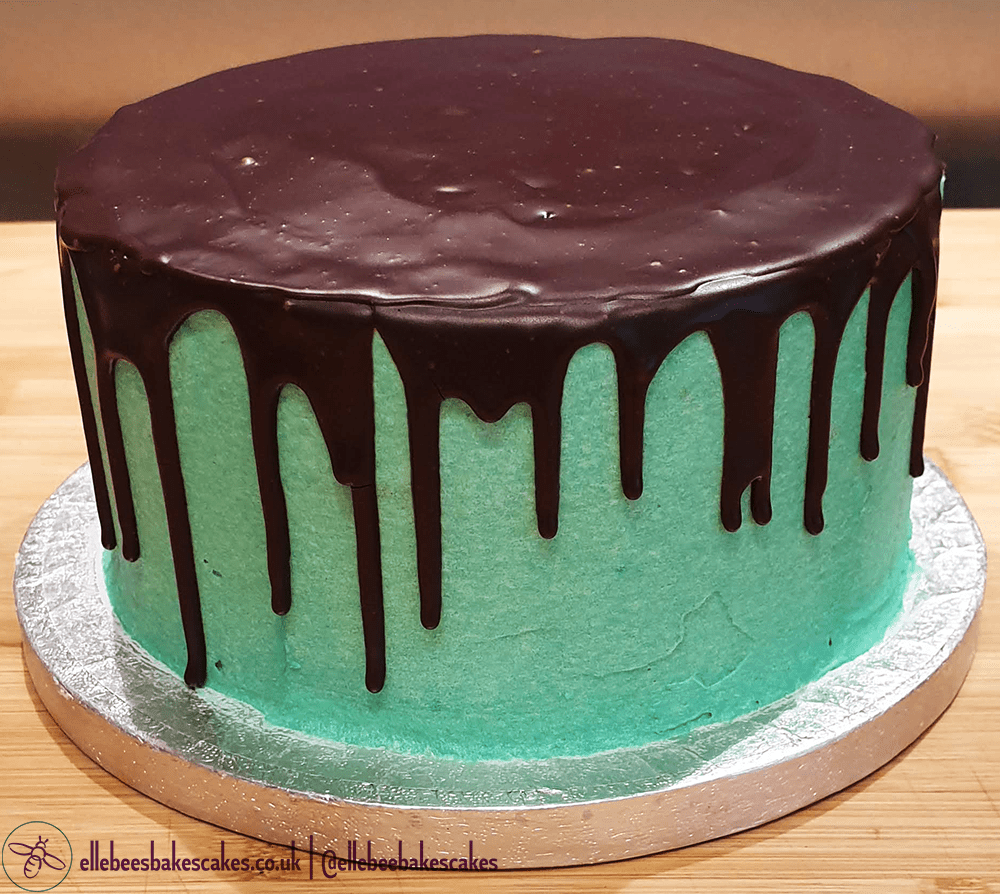
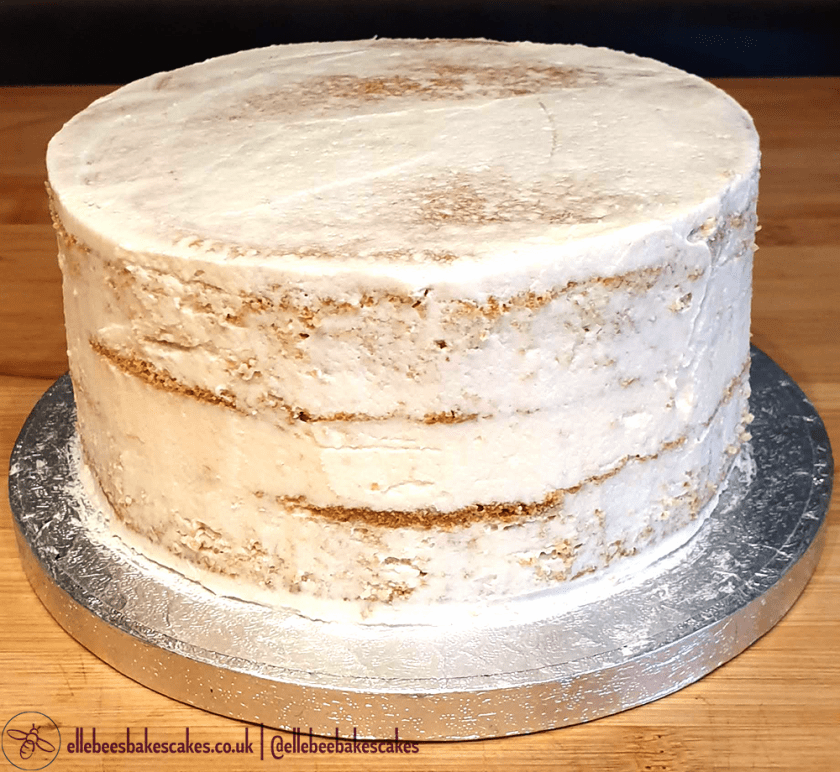
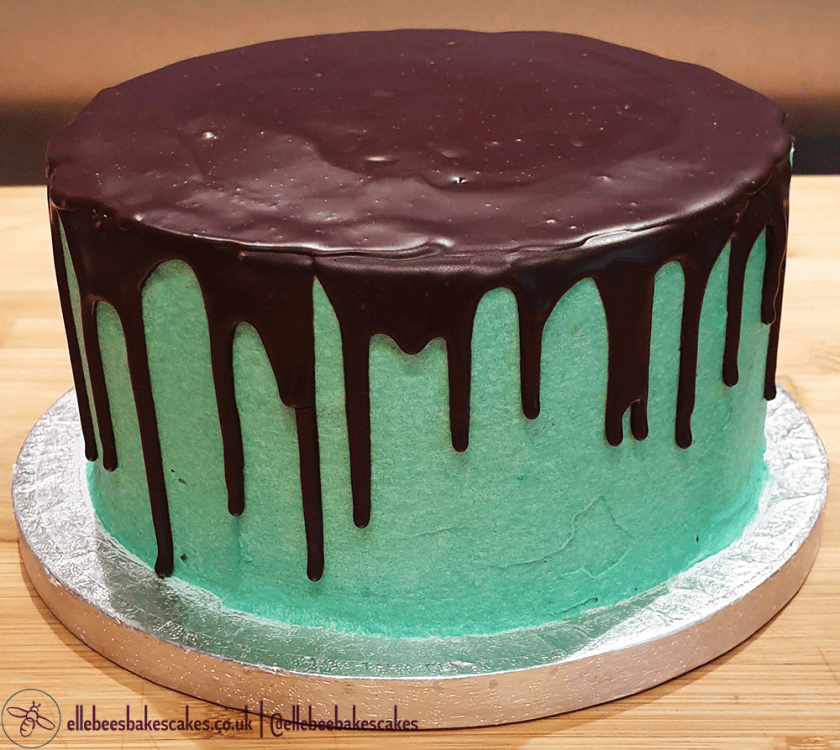
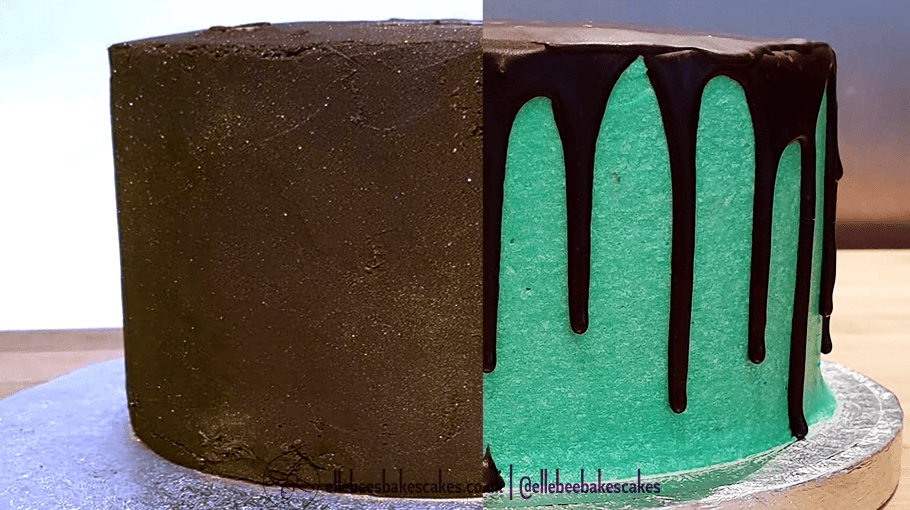
I decorated this 2 layer 6″ (15cm) Victoria sponge (recipe here, I used a 3 eggs weight instead of 2 and split it between two 6″ cake tins) with my vanilla ‘buttercream’ (recipe here), first with a crumb coat, then the coloured ‘buttercream’, then topped it with chocolate ganache dripping down the sides (recipe here).

I applied a spot of buttercream to the centre of the cake board so that the bottom layer of cake wouldn’t move around. I then applied a generous layer of buttercream to the top of that layer using an offset spatula, making sure to keep the top of the buttercream level. I put the second layer on top, top side down.

I applied a thin layer of buttercream to the whole cake using an offset spatula and levelled it with a cake scraper. I put the cake in the fridge overnight to ensure the buttercream set firm.

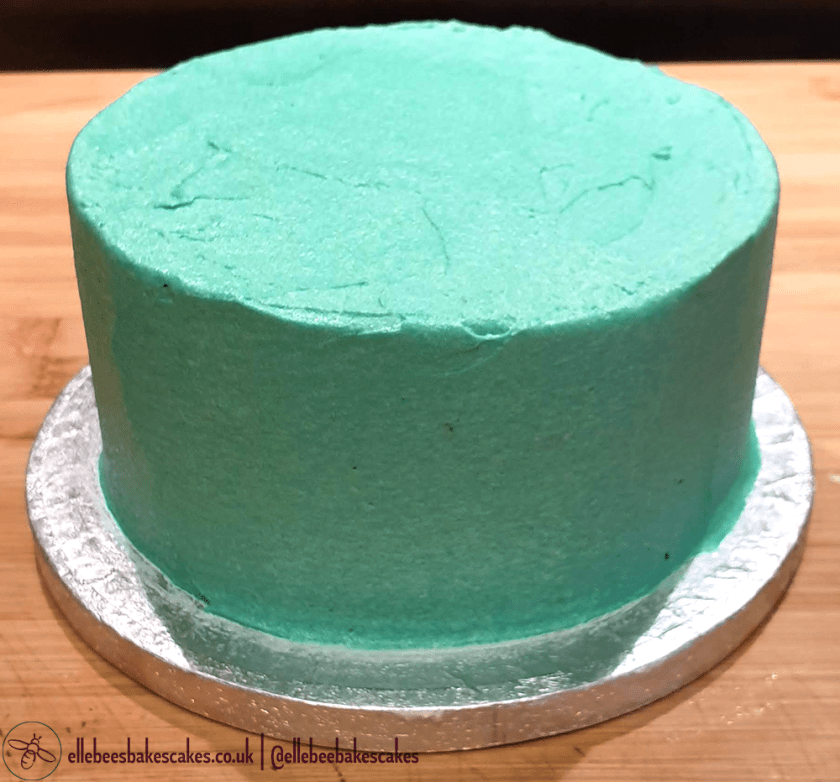
After the crumb coat, about two thirds of the buttercream remained. I coloured the buttercream by folding in green and blue food colouring gel paste to achieve this teal colour – due to the super-concentrated nature of colouring gel paste, the gel from the point of a kebab stick dipped into the colouring paste was all that was needed.

To apply the coloured buttercream, I used the same technique as the crumb coat but applied it more thickly. I smoothed the buttercream with the cake scraper then put it back in the fridge overnight.

For the drips, I prepared a piping bag with a #2 tip and poured in the slightly-cooled ganache. With the cake on a turntable, I turned the cake and allowed the ganache to fall on the edge to drip over the side. Once the entire circumference was covered, I filled in the centre. Depending on how liquid your ganache is at this point, you may need to encourage it to smooth with a palette knife.

I popped the cake back in the fridge overnight for the ganache to set.

Enjoy!

P.S. Don’t have 3 days to decorate this cake? 2 hours in the fridge instead of overnight should be enough to firm up the buttercream and ganache layers, but you can’t skip the chilling completely.

Amazon Associate Links

Most of the baking equipment I used can be found on Amazon, find them here

Chocolate Ganache

There is something about the decadent smoothness of chocolate ganache that is special and unbeatable. Consisting of just two ingredients – dark chocolate and plant-based double cream – it’s simple too.

When decorating a cake, ganache can be used to cover a cake like icing, or drip from the top for a funky decorative flair. However, the two styles of ganache require different ratios of chocolate to cream. Icing ganache has a ratio of 2:1 chocolate:cream, whereas a drip ganache is 1.5:1 chocolate:cream

Ingredients

  • Dark chocolate, chopped and in a heatproof bowl (I prefer to use Lindt 51% cooking chocolate)
  • Plant based double cream

To cover a 4 layer 6″ (15cm) cake, about one kilo of ganache is needed (666g chocolate and 333g double cream).

To drip on top of a 6″ (15cm) cake, about 175g of ganache is needed (105g chocolate and 70g double cream).

Process

  1. Heat up the cream in a saucepan over a low-medium heat until small bubbles appear at the edges, but don’t let it boil
  2. Pour the hot cream over the chocolate and mix with a whisk until combined and smooth
  3. Wait around 10 minutes for the ganache to cool before decorating the cake
    • To cover a cake, use an offset spatula and treat the ganache like buttercream
    • To drip, fill a piping bag with a small round (#2) tip attached and pipe the ganache to the edge of the cake so that it drips over the edge and down the side. Once the edge is covered, fill in the centre

Enjoy!

P.S. Ganache can be used for things other than decorating cakes! It can be used for dipping strawberries, or adding to plant based milk to make a silky hot chocolate, or leave it to cool a bit longer so that it can be piped into choux pastry or even to create decorations using the piping bag!

Vanilla ‘Buttercream’ Icing

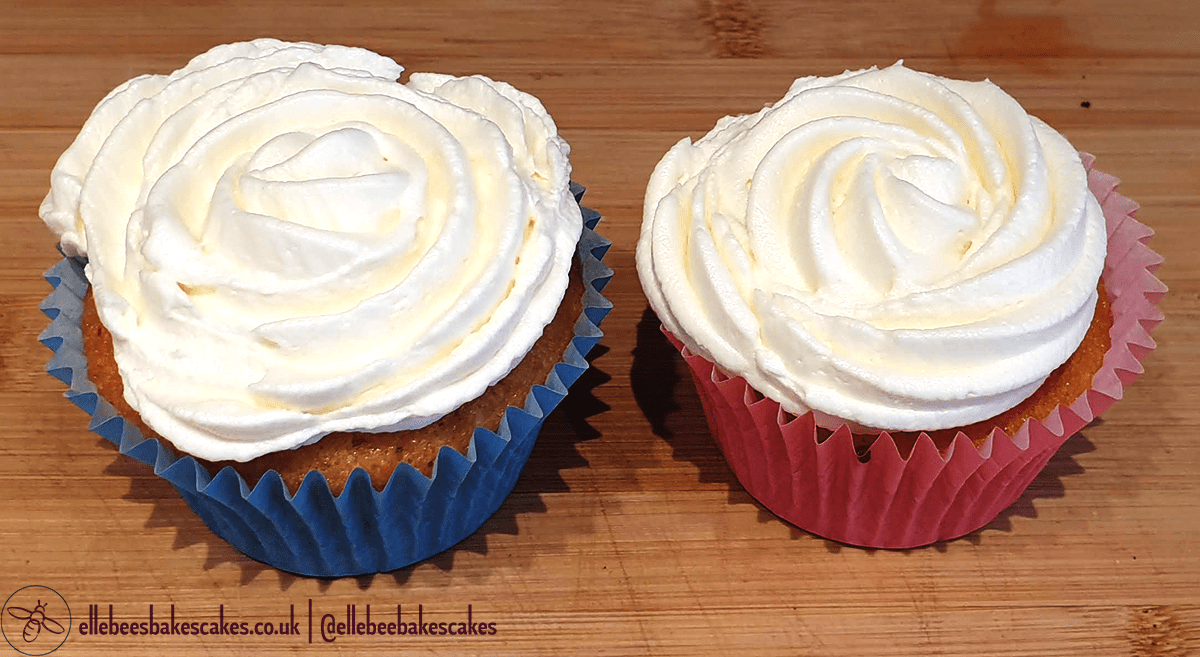
This is something that I have really missed since not being able to have dairy. There is a dairy-free version commercially available, but shelf-stable mass-produced buttercream full of emulsifiers, preservatives, and flavourings pales in comparison to this homemade version. Ready in 15 minutes it takes no time at all to make, and is most definitely worth it.

This recipe will ice 18 cupcakes or one 2-layer 6″ cake.

Ingredients

  • 80g vegetable shortening (I use Trex, but other shortening can be used)
  • 80g margarine
  • 330g icing sugar, sifted
  • 2 tsp vanilla extract, not essence
  • 1 tsp lemon juice – this is to balance out the fats

Process

  1. Put the vegetable shortening and margarine in a stand mixer with paddle attachment and beat for 5-8 minutes, until fully combined, soft, and pale
  2. Add half of the icing sugar and beat for 2 minutes, then add the other half and beat for a further 2 minutes
  3. Add the vanilla extract and lemon juice, and beat for 3 minutes
    • This is also the time to add any colouring; don’t use liquid food colouring as it will make the buttercream too liquid. Gel or powdered colouring work best, and a little goes a long way so start with a tiny amount and gradually build the colour.

Enjoy!

Tips

If your buttercream creates an oily/waxy film in your mouth, this is because the fat hasn’t been fully balanced.  Add more lemon juice 1/2 tsp at a time and beat for 2 minutes each time.

If your buttercream isn’t vanilla-tasting enough, add more vanilla extract 1/2 tsp at a time and beat for 2 minutes each time until desired flavour is reached.

Decorating

If using the buttercream straight away, use a spatula and mix the buttercream until smooth.  This knocks any air bubbles out for a silky, even frosting.  Either use an offset spatula to apply it directly to a cake, or use it in a piping bag.

If making it for use at a later date, put it in an air tight container and in the fridge.  It should last around 1-2 weeks.  Bring back to room temperature and mix out air bubbles before using.